Outstanding Achievements for Global Well-Being and Our Shared Future
TAIPEI, Sept. 18, 2026 /PRNewswire/ -- The 2026 Tang Prize Award Ceremony brought together all six laureates in Taipei on September 18, with five receiving their awards in person and Biopharmaceutical Science laureate Dr. Steven A. Rosenberg taking part remotely. The laureates drew on decades of research, scholarship, and practice to address some of the most pressing challenges facing humanity and share their hopes for the future.
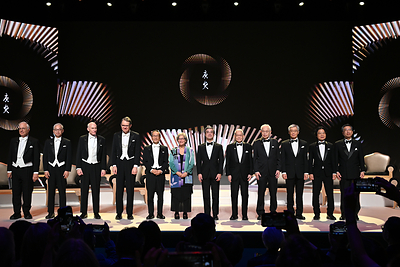
This year marked the first Tang Prize Award Ceremony since the passing of Tang Prize Founder Dr. Samuel Yen-Liang Yin, and a commemorative video was shown in his honor. Dr. Chung-Yao Yin, Chairman of the Tang Prize Foundation, said the framework and spirit established by his father will continue to be carried forward, and that the ceremony represents a continuation of the vision on which the Tang Prize was founded. Academician Chi-Huey Wong, President of the Tang Prize Selection Committee, said the selection committees for all four prize categories have consistently upheld objective, impartial, and professional standards in selecting laureates.
Professor Susan Solomon, the 2026 Tang Prize Laureate in Sustainable Development, noted that today's global environmental challenges may seem just as intractable as ozone depletion once did, but a combination of "science, public engagement, industry participation, and wise policy" enabled humanity to overcome that crisis. She expressed hope that humanity will once again succeed in "the moonshot of safeguarding our environment instead of destroying it."
Among the 2026 Tang Prize Laureates in Biopharmaceutical Science, Dr. Steven A. Rosenberg recalled that four decades ago, his team's work showed that tumor-infiltrating lymphocytes (TILs) derived from patients' tumors could mediate cancer regression, demonstrating that a patient's own lymphocytes could serve as a "living drug" against cancer. The work later led to therapeutic strategies using T cell receptors (TCRs) and chimeric antigen receptors (CARs). Rosenberg called it "a proud example of academic research" that led to lifesaving cancer treatments now available worldwide.
Dr. Michel Sadelain recalled that the idea of targeting CD19 with CAR T cells in the 1990s was rejected by most in academia and industry. He said the only way to advance the concept was to "do it yourself." His team treated its first patient in 2007, and the first CD19-targeted CAR therapies were approved by the U.S. Food and Drug Administration in 2017. Sadelain expressed particular gratitude to "the brave ones who risked their careers when this work was labelled 'science fiction.'"
Dr. Carl H. June said that for patients in the early clinical trials, the question was not whether CAR T-cell therapy was an elegant scientific idea, but whether it could give them more time: "Time with a spouse. Time to see a child grow up. For a child, time simply to grow up." He said patients and their families are "at the heart of this award" because they trusted the research team amid profound uncertainty. He added that whether a treatment reaches the people who need it must be part of how success is measured.
Professor Ge Zhaoguang, the 2026 Tang Prize Laureate in Sinology, noted that Sinology has become a global field of scholarship. Perspectives from different countries and regions are like mirrors held at different angles, together revealing a China that is nuanced and multifaceted. In his view, "the synthesis of East and West, together with pluralism and openness," is the path toward a flourishing field of Sinology.
Professor Bruce Ackerman, the 2026 Tang Prize Laureate in Rule of Law, reflected on growing up in one of New York City's most impoverished neighborhoods in the 1950s. His experience in public schools shaped by John Dewey's philosophy of progressive education encouraged him to explore alternative paths and think independently. At Harvard, he was deeply influenced by John Rawls. To this day, he continues to collaborate with colleagues in academia to explore the underlying sources of the worldwide crisis threatening the future of the rule of law.
Note: Livestream: https://youtube.com/live/DYKirmt37DI?feature=share
 View original content to download multimedia:https://www.prnewswire.co.uk/news-releases/2026-tang-prize-award-ceremony-honors-six-laureates-302883221.html

Während die Dieselpreise in Teilen Italiens neue Höchststände erreichen, zeichnet sich in Luxemburg eine spürbare Entspannung ab – und in Deutschland profitieren Autofahrer nur eingeschränkt von Steuererleichterungen. In Südtirol kletterte der Dieselhöchstpreis in Bozen Medienberichten zufolge auf 2,288 Euro pro Liter und lag damit am Mittwoch über dem Durchschnitt auf den italienischen Autobahnen. Dort wurden im Schnitt 2,287 Euro pro Liter Diesel fällig. Im gesamtstaatlichen Vergleich ist Südtirol damit weiterhin Spitzenreiter bei den Preisen.
Auch in anderen italienischen Regionen zogen die Dieselpreise deutlich an. In Trient stieg der Selbstbedienungspreis auf 2,274 Euro pro Liter, ein Anstieg um 1,1 Cent binnen eines Tages. Die stärksten Preissprünge wurden jedoch nicht in den teuersten Regionen verzeichnet, sondern im Nordosten und im Westen des Landes: In Friaul verteuerte sich ein einmaliges Volltanken von 50 Litern Diesel um 1,25 Euro, in Ligurien um 1,20 Euro, im Latium um 1,15 Euro. Auf den Autobahnen wurden Tagesanstiege von bis zu zwei Cent je Liter registriert. Der Präsident der nationalen Verbraucherunion, Massimiliano Dona, wirft der Regierung in Rom vor, zu wenig gegen die Preisanstiege zu unternehmen, und warnt vor möglichen Folgen für die Inflation.
Parallel dazu zeigt sich in Luxemburg ein gegenteiliger Trend. Dort wird Diesel nach Angaben des Wirtschaftsministeriums ab Mitternacht um 6,2 Cent je Liter günstiger und kostet dann 1,995 Euro. Damit fällt der Preis unter die Marke von zwei Euro. Die Benzinsorten Super 95 und Super 98 bleiben stabil bei 1,837 Euro beziehungsweise 2,049 Euro je Liter. Auch Heizöl wird in Luxemburg billiger: Bei Abnahme von mindestens 1.500 Litern sinkt der Literpreis am Mittwoch ebenfalls um 6,2 Cent auf 1,477 Euro. Der Großherzogtum bewegt sich damit preislich klar unter dem Niveau vieler Regionen in Italien.
In Deutschland wiederum kommt eine bereits beschlossene Steuerentlastung für Autofahrer nur begrenzt an. In Sachsen-Anhalt senkte die Bundesregierung vor rund einer Woche die Steuern auf Kraftstoffe um 17 Cent pro Liter. Laut dem Portal Benzinpreis-blitz kostete Super E10 am Mittwochnachmittag im Landesdurchschnitt 2,12 Euro pro Liter und damit lediglich rund sieben Cent weniger als am Nachmittag vor Inkrafttreten des Rabatts. Der Dieselpreis lag bei 2,19 Euro pro Liter, rund 15 Cent unter dem Vorkrisenniveau. Die Entlastung erreicht damit nicht vollständig die angekündigte Höhe, zudem spielt laut den Erhebungen die Uhrzeit eine wesentliche Rolle: Je nach Tageszeit fällt der Vorteil für Verbraucher unterschiedlich aus.
Im europäischen Vergleich entstehen damit deutliche Preisunterschiede für Dieselverbraucher. Während Italien mit Rekordständen in Teilen des Landes und spürbaren Tagesanstiegen im Fokus steht, nutzt Luxemburg den Spielraum für Preissenkungen. Deutschland versucht, über Steuersenkungen gegenzusteuern, bislang mit begrenzter Durchschlagskraft an der Zapfsäule. Für Verbraucher bleibt das Umfeld volatil – und die Frage, in welchem Umfang staatliche Eingriffe und Marktbewegungen künftig tatsächlich im Portemonnaie der Autofahrer ankommen.