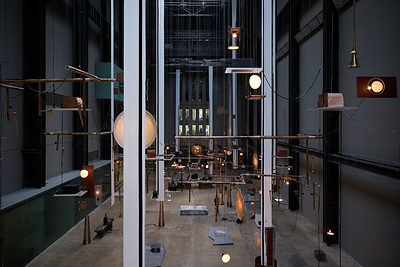
SEOUL, South Korea and LONDON, Oct. 12, 2026 /PRNewswire/ -- Hyundai Motor Company and Tate Modern announce the opening of Hyundai Commission: Tarek Atoui: Hold, a major new multisensory installation by artist and composer Tarek Atoui. Combining sculpture, performance, music, technology and social research, Atoui creates environments where sound is experienced not only through the ears, but through the whole body. For his Hyundai Commission, he has transformed Tate Modern's Turbine Hall into an immersive sonic landscape comprising custom-built wind instruments, percussion, electronics and sculptural objects, woven together to make an orchestra which connects the earth and sky. Through participation and performance, this living environment will constantly evolve throughout the run of the commission.
Hyundai Commission: Tarek Atoui: Hold marks the 11th annual Hyundai Commission and inaugurates the next decade of the Hyundai Motor and Tate partnership extending through 2036. Established in 2014, the partnership represents the longest initial commitment from a corporate partner in Tate's history, encompassing the Hyundai Commission and, since 2019, the Hyundai Tate Research Centre: Transnational.
Atoui's Hyundai Commission is the culmination of over two decades of experimentation, including collaborations with musicians, instrument-makers, engineers and researchers across Asia and Europe. Drawing on these projects, he reimagines shengs, Korean drums, Uzbek horns and custom-built electronic systems.
Hanging above the Turbine Hall ramp, a metal karnai (a ceremonial brass trumpet from Uzbekistan) is joined by two 3D-printed horns that echo and amplify the instrument's elongated form. At the far end of the hall, drum skins, gongs, horns, stones and 20m long textiles are suspended among a network of bamboo and shengs (mouth organs from China and Southeast Asia), through which wind is channeled by a computer-controlled motor. In making the work, Atoui has responded to the extraordinary height, airflows and acoustic character of the Turbine Hall. Lithophone-like stones and warm lights invite visitors to sit, lie, gaze up, and attune themselves to the relationship between sound, materials, architecture and bodies. Drawing on the artist's memories of gathering places, from vine-covered canopies to sheltered courtyards, Hyundai Commission: Tarek Atoui: Hold situates the Turbine Hall as a site for encounter and exchange.
Microphones embedded within the installation sample the sounds produced by the instruments and the bustling backdrop of the Turbine Hall, with custom software reworking and playing them back as layers of the composition. Foregrounding the importance of improvisation in Atoui's practice, these elements contribute to an ever-changing soundscape.
Throughout the six-month duration of the Hyundai Commission, the Turbine Hall will regularly become a site for live sound-based performances, where a network of musicians will 'plug into' Atoui's installation as a sound system. The program will platform both local and international musicians – from instrumentalists to electronic artists, collectives and labels – highlighting the work of Atoui's longstanding collaborators and fostering new connections.
"Hyundai Commission: Tarek Atoui: Hold creates new forms of connection through sound, bringing together diverse cultures and communities. Through his multisensory and collaborative practice, Atoui invites meaningful exchange and collective reflection on our contemporary world."
– DooEun Choi, Art Director, Hyundai Motor Company
The annual Hyundai Commission has attracted over 21.6 million visitors and established a platform for some of the most bold and memorable artworks of the past decade – from Kara Walker's spectacular fountain to Anicka Yi's floating artificial lifeforms. By extending the partnership until 2036, Hyundai Motor and Tate reaffirm their shared, long-term commitment to artistic innovation and public access to contemporary art.
Hyundai Commission: Tarek Atoui: Hold
October 13, 2026 – April 11, 2027, Tate Modern
In partnership with Hyundai Motor
**All images must be accompanied by a credit line below and used only to illustrate an article or feature reviewing or reporting on the Hyundai Commission and the partnership between Hyundai Motor and Tate. Any form of treatment and use of images for front covers may attract a fee and will require prior authorization from the owner and copyright holder of the work. Please contact Tate Press Office for such use: pressoffice@tate.org.uk
Visit the Hyundai Media Hub for more content
 View original content to download multimedia:https://www.prnewswire.co.uk/news-releases/hyundai-motor-and-tate-announce-the-opening-of-hyundai-commission-tarek-atoui-hold-302905675.html

Während die Dieselpreise in Teilen Italiens neue Höchststände erreichen, zeichnet sich in Luxemburg eine spürbare Entspannung ab – und in Deutschland profitieren Autofahrer nur eingeschränkt von Steuererleichterungen. In Südtirol kletterte der Dieselhöchstpreis in Bozen Medienberichten zufolge auf 2,288 Euro pro Liter und lag damit am Mittwoch über dem Durchschnitt auf den italienischen Autobahnen. Dort wurden im Schnitt 2,287 Euro pro Liter Diesel fällig. Im gesamtstaatlichen Vergleich ist Südtirol damit weiterhin Spitzenreiter bei den Preisen.
Auch in anderen italienischen Regionen zogen die Dieselpreise deutlich an. In Trient stieg der Selbstbedienungspreis auf 2,274 Euro pro Liter, ein Anstieg um 1,1 Cent binnen eines Tages. Die stärksten Preissprünge wurden jedoch nicht in den teuersten Regionen verzeichnet, sondern im Nordosten und im Westen des Landes: In Friaul verteuerte sich ein einmaliges Volltanken von 50 Litern Diesel um 1,25 Euro, in Ligurien um 1,20 Euro, im Latium um 1,15 Euro. Auf den Autobahnen wurden Tagesanstiege von bis zu zwei Cent je Liter registriert. Der Präsident der nationalen Verbraucherunion, Massimiliano Dona, wirft der Regierung in Rom vor, zu wenig gegen die Preisanstiege zu unternehmen, und warnt vor möglichen Folgen für die Inflation.
Parallel dazu zeigt sich in Luxemburg ein gegenteiliger Trend. Dort wird Diesel nach Angaben des Wirtschaftsministeriums ab Mitternacht um 6,2 Cent je Liter günstiger und kostet dann 1,995 Euro. Damit fällt der Preis unter die Marke von zwei Euro. Die Benzinsorten Super 95 und Super 98 bleiben stabil bei 1,837 Euro beziehungsweise 2,049 Euro je Liter. Auch Heizöl wird in Luxemburg billiger: Bei Abnahme von mindestens 1.500 Litern sinkt der Literpreis am Mittwoch ebenfalls um 6,2 Cent auf 1,477 Euro. Der Großherzogtum bewegt sich damit preislich klar unter dem Niveau vieler Regionen in Italien.
In Deutschland wiederum kommt eine bereits beschlossene Steuerentlastung für Autofahrer nur begrenzt an. In Sachsen-Anhalt senkte die Bundesregierung vor rund einer Woche die Steuern auf Kraftstoffe um 17 Cent pro Liter. Laut dem Portal Benzinpreis-blitz kostete Super E10 am Mittwochnachmittag im Landesdurchschnitt 2,12 Euro pro Liter und damit lediglich rund sieben Cent weniger als am Nachmittag vor Inkrafttreten des Rabatts. Der Dieselpreis lag bei 2,19 Euro pro Liter, rund 15 Cent unter dem Vorkrisenniveau. Die Entlastung erreicht damit nicht vollständig die angekündigte Höhe, zudem spielt laut den Erhebungen die Uhrzeit eine wesentliche Rolle: Je nach Tageszeit fällt der Vorteil für Verbraucher unterschiedlich aus.
Im europäischen Vergleich entstehen damit deutliche Preisunterschiede für Dieselverbraucher. Während Italien mit Rekordständen in Teilen des Landes und spürbaren Tagesanstiegen im Fokus steht, nutzt Luxemburg den Spielraum für Preissenkungen. Deutschland versucht, über Steuersenkungen gegenzusteuern, bislang mit begrenzter Durchschlagskraft an der Zapfsäule. Für Verbraucher bleibt das Umfeld volatil – und die Frage, in welchem Umfang staatliche Eingriffe und Marktbewegungen künftig tatsächlich im Portemonnaie der Autofahrer ankommen.