BEIJING, Sept. 20, 2026 /PRNewswire/ -- JA announced that its independently developed and packaged P-type heterojunction (P-HJT) modules were successfully launched on September 17 and entered their planned orbit.
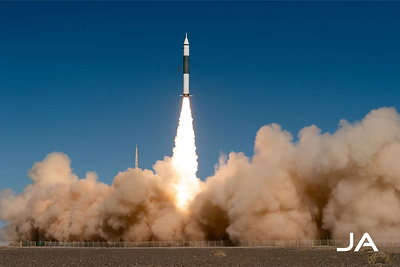
The mission marks JA's first in-orbit test of P-HJT modules, with future large-scale commercial applications as a long-term goal.
"Energy innovation has long been a driving force behind human progress," said Dr. Ouyang Zi, Chief Technology Officer of JA. "As satellite deployment accelerates and the space economy expands, solar power is expected to play an increasingly important role in future space infrastructure. Developing more cost-competitive solar solutions for space is therefore an important strategic priority.
"JA has spent years building expertise in photovoltaic technology, with the reliability and long-term performance of its products proven through large-scale manufacturing and deployment across a wide range of terrestrial applications. This in-orbit test extends those capabilities into the space environment and marks an important step in JA's exploration of future space energy solutions.
"Through real-world testing in orbit, we aim to assess the reliability and degradation of crystalline silicon technology in low-Earth orbit and explore more cost-competitive options for future space energy systems. The technology will require long-term validation, but we believe it is a direction worth pursuing."
In orbit, the JA modules will be exposed to harsh conditions, including intense radiation, high-energy particles and extreme temperature swings. By comparing in-orbit performance data with results from ground-based simulations, JA will assess the long-term reliability and degradation of P-HJT technology in low-Earth orbit.
If the validation targets are achieved, the program could help accelerate the adoption of mature crystalline silicon technologies as an alternative to gallium arsenide in low-Earth-orbit applications, potentially lowering the cost of satellite power systems. It could also support the development of satellite internet, remote sensing, space communications, space-based computing and other low-Earth-orbit applications.
JA will use the mission as a starting point to further strengthen its module R&D and manufacturing capabilities and advance scalable energy solutions for space exploration and commercial space applications.
Space PV remains at an early stage of exploration and validation, and large-scale commercialization remains highly uncertain. JA currently has no orders related to space PV, and the program has no material impact on its current operating performance.
 View original content to download multimedia:https://www.prnewswire.co.uk/news-releases/jas-space-pv-products-reach-orbit-starting-space-validation-302883945.html

Das Schweizer Studio Urban Games bringt seine erfolgreiche Verkehrssimulation in die nächste Runde: Transport Fever 3 ist ab sofort erhältlich – erstmals auch in einer Version für macOS. Spielerinnen und Spieler bauen darin über mehr als 125 Jahre Transportgeschichte hinweg ein eigenes Verkehrs- und Logistikimperium auf, von den ersten Pferdekutschen und Dampflokomotiven bis hin zu modernen Düsenjets, Supertankern, Hochgeschwindigkeitszügen und Helikoptern. Der Titel setzt damit die Tradition von Genre-Klassikern wie Transport Tycoon fort und positioniert sich erneut als Konkurrenz zu Städten-Simulationen wie Cities: Skylines, allerdings mit klarem Fokus auf Transport und industrielle Verknüpfungen.
Auf dem Mac richtet sich Transport Fever 3 klar an Besitzer aktueller Hardware. Urban Games verlangt mindestens einen M2‑Pro‑Chip, 16 Gigabyte Arbeitsspeicher, 90 Gigabyte freien Speicherplatz und macOS Sequoia 15. Empfohlen wird ein M4 Pro oder besser mit mindestens 24 Gigabyte RAM. Vertrieben wird das Spiel über Steam und GOG, die Einstiegsversion kostet ab 49,99 Euro. Ob zusätzlich eine Veröffentlichung im Mac App Store geplant ist, ist noch offen. Die Simulation bietet eine deutschsprachige Benutzeroberfläche und Vertonung; Videoeinblicke in das Spiel stellt der Entwickler auf YouTube bereit.
Inhaltlich bleibt Transport Fever 3 dem Kern des Genres treu, vertieft aber die Komplexität. Spieler verbinden Städte und Industrie-Standorte, organisieren Linien für Busse, Straßenbahnen, Lkw, Eisenbahnen, Schiffe, Flugzeuge und Helikopter und optimieren so den Transport von Personen und Gütern. Einnahmen generieren alle Transporte, doch zugleich steigen mit jedem Fahrzeug und jeder neuen Strecke die laufenden Kosten. Zusätzlich müssen mehrstufige Produktionsketten bedacht werden: Rohstoffe wie Holz gelangen zunächst ins Sägewerk, bevor sie als weiterverarbeitetes Produkt in die Städte geliefert werden. Fehler in der Planung oder ungenaue Umsetzung können dazu führen, dass sich Systeme gegenseitig blockieren – etwa bei langen Verbindungen über mehrere Kilometer oder im dicht getakteten innerstädtischen Verkehr.
Transport Fever 3 adressiert diese Komplexität mit einem stärker geführten Einstieg und Szenarien. Eine Einführung erläutert Schritt für Schritt grundlegende Mechaniken wie Straßenbau, Linienplanung und Fahrzeugkauf. Spezielle Szenarien führen anschließend in kompakter Form durch komplexere Zusammenhänge und setzen auf abgeschlossene, erzählerisch eingebettete Aufgaben – etwa wenn eine Stadt für einen Großanlass wie Mardi Gras vorbereitet oder ein Dorf bei der wirtschaftlichen Entwicklung unterstützt werden soll. Das Spiel legt dabei Wert auf Detailsteuerung bis hin zu Ampelphasen an Kreuzungen und erlaubt es, ein fein verzweigtes Netz aufzubauen, in dem erfahrene Spieler jede Linie und jeden Zug kennen. Besitzer von Transport Fever 2 erhalten beim Kauf der Standard- oder Deluxe-Edition auf derselben Plattform einen Treuerabatt von 10 Prozent – ein Angebot, das die bestehende Community in die neue Version mitnehmen soll.