LG Electronics' Decades of Manufacturing Know-How Meets NVIDIA's Robotics Stack At LG's New Data Factory in Seoul
News Summary
SEOUL, South Korea, Aug. 18, 2026 /PRNewswire/ -- LG Electronics (LG) today announced that it is accelerating its robotics collaboration with NVIDIA. LG hosted senior NVIDIA officials at its Data Factory, currently under construction at the company's Yangjae R&D Campus in Seoul, to review the direction of the two companies' collaboration and discuss ways to generate further synergies.
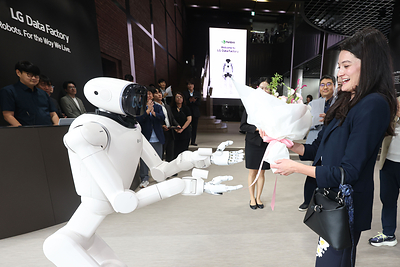
LG Group and NVIDIA signed a memorandum of understanding (MOU) for strategic collaboration on future business initiatives at NVIDIA's headquarters in Santa Clara, California, on August 13 (local time). Reconvening just four days later at LG's Data Factory signals that the two companies intend to move quickly to solidify the strategic cooperation and speed up commercialization of the robotics business.
Officials from both companies also reviewed the current status of LG's Data Factory, which is scheduled to be fully operational by the end of the year. LG has deployed its self-developed, field-proven LG CLOiD™ home robots at scale to generate, collect and learn from data.
The LG's Data Factory features training spaces where robots practice a range of tasks, as well as dedicated areas for validating and refining the resulting data sets. There is a replicated home environment where LG CLOiD learns and repeats cleaning tasks, and a simulated manufacturing space – modeled on LG's washing machine plant in Tennessee – where LG CLOiD units move, stack and assemble a variety of parts. The robots are also being deployed in LG CNS's logistics automation solutions and in a space where LG Innotek trains robotic hands. Data collected across these environments will be linked with NVIDIA's robotics stack, where it is augmented and synthesized into high-quality data for robot learning.
For LG, the core competitiveness of physical AI is its ability to help build a "data flywheel," where high-quality data is repeatedly secured and then used to train and continuously improve robots. Integrating detailed data gathered from LG's manufacturing and logistics operations over decades with NVIDIA's robotics stack is expected to produce a world-class data flywheel that will help set LG apart from competitors.
The Data Factory serves as a space where robots collect data through physical learning and as a forward base for expanding, synthesizing and amplifying robot-learning data collected from LG's manufacturing and logistics sites, and home appliances worldwide. NVIDIA's physical AI technologies – including NVIDIA Omniverse libraries, NVIDIA Cosmos open world models and the open NVIDIA Isaac robotics development platform – are used from data to deployment.
Spanning four floors – one basement level and three above ground – with a total floor area of 10,000 square meters, the Yangjae facility will house several hundred robots by the end of the year. LG also plans to continue upgrading its data-learning systems.
By the end of this year, training data collected directly at the facility and data synthetically generated and augmented using NVIDIA Cosmos open world models are expected to total 100,000 hours, equivalent to roughly 12 years of data.
LG plans to use this data to advance its Robot Foundation Model (RFM), which underpins the performance of humanoid robots, as it continues to build its robotics competitiveness.
LG has designated this year as the starting point for its robotics business push and is moving quickly to strengthen its capabilities. Last month, the company established a Robotics Business Center. Reporting directly to the CEO, the center oversees LG's companywide robotics business and has been tasked with improving execution and efficiency.
The company has established a strong presence in the industrial and commercial robotics markets and plans to expand into home robotics. Backed by proven expertise in manufacturing and developing core robotic components, including actuators, LG delivers differentiated competitiveness spanning from components to finished products. Combined with its Data Factory, which collects and manages the large-scale data needed for robot learning and operation, these strengths will further accelerate LG's transformation into a comprehensive robotics solutions provider with both hardware and software capabilities.
"Through the synergy built on 'One LG' – bringing together core capabilities across the Group – and strategic collaboration with global partners, we will secure our competitiveness in physical AI and become a comprehensive robotics solutions provider," said Lyu Jae-cheol, CEO of LG Electronics.
About LG Electronics, Inc.
LG Electronics is a global innovator in technology and consumer electronics with a presence in almost every country and an international workforce of more than 75,000. LG's four Companies – Home Appliance Solution, Media Entertainment Solution, Vehicle Solution and Eco Solution – combined for global revenue of over KRW 89 trillion in 2025. LG is a leading manufacturer of consumer and commercial products ranging from TVs, home appliances, air solutions, monitors, automotive components and solutions, and its premium LG SIGNATURE and intelligent LG ThinQ brands are familiar names world over. Visit www.LG.com/global/newsroom/ for the latest news.
 View original content to download multimedia:https://www.prnewswire.co.uk/news-releases/lg-electronics-accelerates-robotics-collaboration-with-nvidia-302853864.html

Postauto treibt den Einsatz autonomer Fahrzeuge in der Ostschweiz voran und bereitet nach eigenen Angaben Europas grösstes Robo-Taxi-Netz vor. Das Bundesamt für Strassen (Astra) hat dem Unternehmen eine Ausnahmebewilligung erteilt, damit die speziell ausgerüsteten E-Autos im St. Galler Rheintal sowie in den Kantonen Appenzell Ausserrhoden und Appenzell Innerrhoden automatisch verkehren dürfen. Seit dem 1. Juni sind die Fahrzeuge in einem rund 80 Quadratkilometer grossen Gebiet unterwegs – vorerst noch zu Testzwecken und mit Sicherheitsfahrerinnen und -fahrern an Bord.
Herzstück des Projekts ist die Flotte von bis zu 25 sogenannten "AmiGo"-Fahrzeugen, die im Endausbau mit Automatisierungsgrad Level 4 fahren sollen. Postauto kooperiert dafür mit Apollo Go, der Robotaxi-Sparte des chinesischen Technologiekonzerns Baidu. Die Fahrzeuge werden im typischen Postauto-Gelb lackiert und elektrisch betrieben. Während der Testphase dürfen die Sicherheitsfahrer ihre Hände vom Lenkrad nehmen; sie können jedoch jederzeit eingreifen, wenn die Situation es erfordert – etwa an unübersichtlichen Verzweigungen oder bei forsch auftretendem Gegenverkehr.
Im Alltagstest auf einer festgelegten Route in Altstätten (SG) zeigt sich das System laut Projektbeteiligten bereits weitgehend stabil, auch wenn der Fahrkomfort in Kurven noch nicht an einen menschlichen Chauffeur heranreicht. Auffällig ist das sehr defensive Verhalten, etwa vor Fussgängerstreifen, wo das Fahrzeug früh abbremst, selbst wenn sich Personen noch in einiger Entfernung befinden. Gesteuert wird der Betrieb zusätzlich aus einer Leitstelle, in der Operatorinnen und Operatoren die Fahrten überwachen und bei Bedarf aus der Ferne eingreifen können.
Der reguläre Betrieb mit fahrerlosen Fahrzeugen ist ab 2027 vorgesehen. Postauto plant, dass Fahrgäste in der Region ihre autonome Fahrt dann probeweise per App buchen können. Astra-Direktor Jürg Röthlisberger sieht im automatisierten Fahren eine grosse Chance und spricht dem Projekt das Potenzial eines "Gamechangers" zu. Es ist nicht der erste Versuch mit selbstfahrenden Fahrzeugen in der Schweiz, aber nach Umfang und Einsatzgebiet der bislang weitreichendste. Die Technologie soll schrittweise verfeinert und insbesondere für ländliche Regionen erprobt werden, in denen flexible, bedarfsgesteuerte Angebote die bestehende Grunderschliessung ergänzen könnten.