ULAANBAATAR, Mongolia, Aug. 24, 2026 /PRNewswire/ -- From August 17 to 28, 2026, the 17th session of the Conference of the Parties to the United Nations Convention to Combat Desertification (UNCCD COP17) is being held in Ulaanbaatar, Mongolia. During the conference, LONGi participated in several side events, systematically presenting the enormous potential of PV technology to enhance the resilience of global food supply, and officially released its solutions for PV-powered food security.
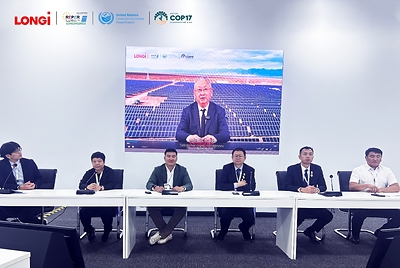
At a side event titled "From Desert to Asset – Comprehensive Solutions for Integrated PV-Based Ecological Restoration," co-hosted by the School of Social Sciences of Tsinghua University and the China Green Foundation, Li Zhenguo, founder and Chief Technology Officer of LONGi, joined via video link and noted that traditional food production relies heavily on natural photosynthesis and climatic conditions. Extreme weather events such as droughts and floods have severely impacted agricultural production, and global climate change is placing unprecedented pressure on an already fragile food supply system. However, as costs decline, PV technology can not only reduce carbon emissions but also offer a new solution for enhancing the resilience of global food supply.
Li Zhenguo recently published a forward-looking Perspective article titled "Photovoltaics for food security" in the leading international academic journal Nature Sustainability, in which he systematically set out two technological pathways with practical application prospects.
Pathway 1: PV-driven artificial synthesis of starch from carbon dioxide. PV-generated electricity is used to electrolyze water and produce green hydrogen, which is then coupled with captured CO₂ to synthesize green methanol. This methanol is subsequently converted into starch through oxidation, polymerization, and other processes. Compared with the solar energy utilization efficiency of about 2% in traditional natural photosynthesis, this pathway can raise efficiency to 7–10%. Calculations show that deploying PV on just 3.7% of the Sahara Desert could generate 26 trillion kWh of green electricity, enough to synthesize 3 billion tonnes of food and meet the current global food demand.
Pathway 2: PV-driven "energy-water-food" nexus system. By building PV power plants in desert areas, the shading effect of PV modules reduces soil moisture evaporation, improves the soil microclimate, and lowers irrigation requirements. Combined with PV-powered seawater desalination and inter-regional water transfer projects, this approach can gradually transform desert land that was previously unsuitable for cultivation into arable farmland.
In fact, LONGi has already been actively exploring this approach in the Kubuqi Desert in Inner Mongolia, China – generating electricity on the panels, planting crops under the panels, and raising livestock between the panel rows. Under the PV panels, the once barren land is being revitalized. This practice verifies the feasibility of integrated PV-ecology-agriculture development and provides a replicable Chinese solution for the coordinated development of ecological restoration and food production in desertification-prone areas.
The theme of this year's COP17 is "Restoring Land, Restoring Hope." LONGi actively participated in multiple side events, engaging in in-depth exchanges with government agencies, scientists, and corporate representatives from around the world, and sharing Chinese experience in the deep integration of PV with desertification control and ecological restoration.
From cutting-edge laboratory exploration to on-the-ground validation in deserts, PV is evolving from an energy solution into a cornerstone of sustainable development. Looking ahead, LONGi will leverage Solar (PV)-plus-Storage technologies to actively address climate change, continue to promote the deep integration of PV with ecology, agriculture, water resources and other fields, build a more resilient global sustainable development system, and ensure that more affordable, safer, and more accessible green energy truly benefits everyone.

 View original content to download multimedia:https://www.prnewswire.co.uk/news-releases/longi-at-unccd-cop17-li-zhenguo-explains-two-technological-pathways-for-pv-powered-food-security-302857978.html

Die Schweiz stimmt an diesem Wochenende über eine der umstrittensten Initiativen der vergangenen Jahre ab: „Keine 10-Millionen-Schweiz!“. Der Vorstoß der nationalkonservativen Schweizerischen Volkspartei (SVP), auch bekannt als Schweizerische Volkspartei oder Swiss People's Party, sieht vor, die ständige Wohnbevölkerung des Landes bis 2050 auf maximal zehn Millionen Menschen zu begrenzen. Nach ersten Hochrechnungen tendieren die Stimmbürgerinnen und Stimmbürger dazu, die Initiative abzulehnen – ein Ergebnis, das im Vorfeld keineswegs sicher schien.
Die Initiative, die in der Verfassung verankert werden soll, würde den Bund verpflichten, Gegenmaßnahmen zu ergreifen, sobald die Bevölkerung 9,5 Millionen erreicht. Die Schweiz zählte Ende 2025 bereits gut 9,1 Millionen Einwohner – rund 1,7 Millionen mehr als 2002. Haupttreiber des Wachstums ist die Zuwanderung. Rund 28% der im Land lebenden Menschen besitzen keinen Schweizer Pass. Viele stammen aus EU-Staaten wie Italien, Deutschland und Portugal, hinzu kommen Personen aus Drittstaaten, darunter Asylsuchende.
Unterstützer der Initiative argumentieren, das Land stoße an seine Belastungsgrenzen. Sie verweisen auf steigende Mieten, überlastete Verkehrswege, Staus sowie eine als problematisch wahrgenommene Entwicklung bei Gewalt und Kriminalität, die sie mit einer höheren Zuwanderung verknüpfen. Ziel sei es laut Kampagnenmotto, „zu bewahren, was wir lieben“. Die SVP wirbt mit auffälligen Aufklebern, Fahnen und Plakaten in Nationalfarben, um eine Begrenzung des Bevölkerungswachstums als Schutz der Lebensqualität zu präsentieren.
Gegen die Initiative stellen sich der Bundesrat, das Parlament, die Kantone sowie die meisten übrigen großen Parteien, gestützt von Wirtschaftsverbänden und Gewerkschaften. Sie warnen, ein starres Bevölkerungs- und damit faktisches Zuwanderungslimit könne den bereits bestehenden Arbeitskräftemangel verschärfen. Laut Bundesamt für Statistik waren im ersten Quartal 2026 rund 1,87 Millionen ausländische Erwerbstätige in der Schweiz beschäftigt. Etwa vier von fünf kamen aus EU- oder EFTA-Staaten oder dem Vereinigten Königreich, der Rest aus Drittstaaten. Viele arbeiten in Bereichen wie Gesundheitswesen, Bau und Gastgewerbe – Sektoren, die stark auf Personal aus dem Ausland angewiesen sind.
Ein weiterer Konfliktpunkt ist das Verhältnis zur Europäischen Union. Die Initiative sieht vor, dass die Schweiz in letzter Konsequenz das Abkommen über die Personenfreizügigkeit mit der EU kündigen müsste, sollte die Obergrenze sonst nicht zu halten sein. Gegner befürchten, dies könnte die bilateralen Beziehungen und den Zugang zum europäischen Arbeitsmarkt belasten. Befürworter halten dem entgegen, nur mit klaren quantitativen Vorgaben lasse sich der Druck auf Wohnungsmarkt, Infrastruktur und öffentliche Dienste nachhaltig begrenzen.
Parallel zur Abstimmung über die 10-Millionen-Grenze entscheiden die Stimmberechtigten auch über eine Verschärfung des Zivildienstgesetzes. Im Fokus der innenpolitischen Debatte steht jedoch vor allem die Frage, wie die Schweiz Wachstum, Wohlstand und gesellschaftlichen Zusammenhalt künftig austarieren will. Das Ergebnis der Volksabstimmung dürfte zwar die Initiative selbst klären, die Grundsatzdiskussion über Zuwanderung, Arbeitskräftebedarf und Lebensqualität in der Alpenrepublik jedoch kaum beenden.