CLARK, N.J., Oct. 12, 2026 /PRNewswire/ -- GEP Global Supply Chain Volatility Index — a leading indicator tracking demand conditions, shortages, transportation costs, inventories and backlogs, based on a monthly survey of 27,000 businesses — showed global manufacturers ramping up purchases of raw materials and components in September as underlying demand strengthened.
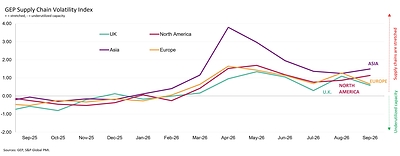
Global input demand growth rose to its strongest since May and was close to its 2026 high, signaling firmer manufacturing activity heading into the fourth quarter. Purchasing strengthened across North America, Asia and Europe, with particularly strong increases in the United States, Germany, Taiwan and South Korea.
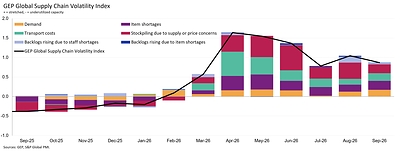
At the same time, supply pressures intensified. Shortages increased for the first time since May, while global transportation costs also rose. Shortages of oil and oil-based products were particularly acute, creating renewed cost and availability pressures for manufacturers.
"Manufacturers are buying more because demand is strengthening, but they're doing so at a time when shortages and transportation costs are starting to rise again," said John Piatek, vice president, GEP Consulting. "For companies, that means the priority shifts from simply protecting inventory to securing supply and controlling costs. If demand continues to build through the fourth quarter, businesses that wait will face tighter availability and higher input costs."
Interpreting the data:
Index > 0, supply chain capacity is being stretched. The further above 0, the more stretched supply chains are.
Index < 0, supply chain capacity is being underutilized. The further below 0, the more underutilized supply chains are.
SEPTEMBER 2026 REGIONAL KEY FINDINGS
SEPTEMBER 2026 KEY FINDINGS
For more information, visit www.gep.com/volatility.
Note: Full historical data dating back to January 2005 is available for subscription. Please contact economics@spglobal.com.
The next release of the GEP Global Supply Chain Volatility Index will be 8 a.m. ET, Nov. 11, 2026.
About the GEP Global Supply Chain Volatility Index
The GEP Global Supply Chain Volatility Index is produced by S&P Global and GEP. It is derived from S&P Global's PMI® surveys, sent to companies in over 40 countries, totaling around 27,000 companies. The headline figure is a weighted sum of six sub-indices derived from PMI data, PMI Comments Trackers and PMI Commodity Price & Supply Indicators compiled by S&P Global.
A Supply Chain Volatility Index is also published at a regional level for Europe, Asia, North America and the U.K. For more information about the methodology, click here.
Media Contacts
Derek Creevey
Director, Public Relations
GEP
Phone: +1 646-276-4579
Email: derek.creevey@gep.com
Joe Hayes
Senior Principal Economist
S&P Global Market Intelligence
Phone: +44-1344-328-099
Email: joe.hayes@spglobal.com
 View original content to download multimedia:https://www.prnewswire.co.uk/news-releases/manufacturers-ramp-up-purchasing-in-september-as-global-demand-strengthens-gep-global-supply-chain-volatility-index-302905220.html

Eine anonyme E-Mail an die US-Botschaft in Bern hat kurz vor dem Auftritt von US-Präsident Donald Trump beim Weltwirtschaftsforum in Davos ein Ermittlungsverfahren der Schweizer Bundesanwaltschaft ausgelöst – und zur Festnahme einer WEF-Mitarbeiterin geführt. Inzwischen ist klar: Die gegen die IT-Expertin erhobenen Vorwürfe eines geplanten Attentats waren nicht zu belegen. Die Bundesanwaltschaft teilte mit, die in der Sache eröffneten Ermittlungen wegen strafbarer Vorbereitungshandlungen zu einem Mord seien eingestellt worden.
Die Warnmail war laut Medienberichten der Tamedia-Gruppe wenige Stunden vor Trumps Rede eingegangen. Der anonyme Absender schilderte in fehlerhaftem Englisch eine angeblich „dringliche Bedrohung“ für das Leben des US-Präsidenten in Davos und bezeichnete die später festgenommene Frau iranischer Herkunft als Agentin, die eine entsprechende Operation koordiniert habe. Die US-Botschaft leitete den Hinweis an die Schweizer Behörden weiter; diese erklärten, sie hätten die Warnung „sehr ernst“ genommen und seien „sofort aktiv“ geworden.
Tatsächlich arbeitete die Beschuldigte nicht am Tagungsort in Davos, sondern in der WEF-Zentrale im Genfer Vorort Cologny. Dort wurde sie nach Angaben der Bundesanwaltschaft festgenommen, mehrere Stunden lang bis tief in die Nacht vernommen und ihre Telefone sowie ihr Computer wurden beschlagnahmt und ausgewertet. Im Zuge dieser Maßnahmen habe sich jedoch gezeigt, dass sich keiner der in der anonymen E-Mail erhobenen Punkte erhärten ließ. Für alle Aspekte der Anschuldigungen seien keine Beweise gefunden worden, hieß es zur Begründung für die Einstellung des Verfahrens.
Die betroffene Mitarbeiterin, eine gebürtige Iranerin, war nach den Medienberichten kurz nach dem Vorfall beim WEF nicht mehr beschäftigt. Zu den Gründen äußerte sich die Organisation nicht; auf entsprechende Anfragen gab es zunächst keine Stellungnahme. Damit bleiben nach dem spektakulären Fehlalarm vorerst Fragen offen – etwa zur Herkunft und Glaubwürdigkeit des anonymen Hinweises –, während die Schweizer Strafverfolger den Fall strafrechtlich abgeschlossen haben.