MUNICH, July 13, 2026 /PRNewswire/ -- During the Intersolar Europe 2026 exhibition, Sungrow and TÜV Rheinland jointly launched the world's first quantitative long-term reliability standards for PV inverters, including 2 PfG 3325 Reliability test qualification for IGBT modules in photovoltaic power systems and power electronic converter systems and 2 PfG 3328 - Part 2 Specifications for Reliability Testing and Assessment of Power Electronic Products - Part 2: Power Conversion Equipment (PCE).
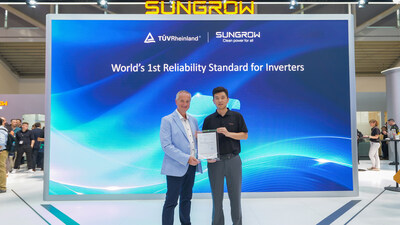
Sungrow's SG510HX string inverter and its IGBT modules were among the first products certified under the two standards, providing early validation of the framework in practical applications.
Meeting the Demands of Modern PV Plants
As PV power plants continue to expand into increasingly demanding environments such as deserts, offshore locations, and high-altitude regions, ensuring inverter reliability over 25 years of operation has become increasingly important for project owners and investors. However, existing reliability qualification methodologies were not originally designed to fully capture the increasingly diverse and demanding operating conditions of modern PV plants, creating a gap between laboratory qualification and long-term field performance.
To address this challenge, Sungrow and TÜV Rheinland have developed a comprehensive reliability evaluation framework that enables a more scientific, quantitative, and traceable assessment of inverter lifetime performance.
From Systems to Components: A Unified Reliability Validation Framework
Facing the shortcomings of traditional standards, the dual framework establishes a robust, quantifiable reliability methodology spanning the entire "system-component" validation continuum.
Together, the standards establish a system-to-component validation chain: 2 PfG 3325 provides a quantitative data basis for inverter -level reliability modeling and supplier evaluation, while 2 PfG 3328 - Part 2 defines a unified inverter -level validation framework with testable and traceable criteria.
New Standards Upgraded for Complex Scenarios
Addressing the issue of insufficient coverage in traditional standard scenarios, the standards added several enhanced test items designed for complex operating conditions.
The standards significantly strengthen reliability verification by expanding test coverage for complex operating scenarios.
Quantifiable Lifetime Assessment
To improve the quantitative assessment of long-term field reliability, the standards establish data-driven lifetime models based on extensive field performance data from PV power plants. The standards also draw on automotive components' reliability testing and quality verification standards such as VW 80000 and GMW 3172, adopting more stringent test approaches to evaluate long-term stability under complex operating conditions.
"The two standards establish a structured and verifiable framework for long-term inverter reliability evaluation, offering valuable references for manufacturers, investors, and insurers in assessing lifecycle performance," said Thomas Haupt, Vice President of Solar & Commercial Products, European Region of TÜV Rheinland Group.
Why Sungrow
As the pioneering architect of these standards, Sungrow leveraged its 29 years of expertise in power electronics together with extensive global project experience and operational insights across diverse climates and applications. Steering the reliability evaluation of PV inverters away from subjective empirical deductions toward a scientifically quantifiable, verifiable, and traceable future.

Photo - https://mma.prnewswire.com/media/3005616/111.jpg
Logo - https://mma.prnewswire.com/media/1344575/Logo.jpg
 View original content:https://www.prnewswire.co.uk/news-releases/sungrow-and-tuv-rheinland-redefine-industry-rule-worlds-first-inverter-long-term-reliability-corporate-standards-released-302823493.html

In der Schweiz entscheiden die Stimmbürgerinnen und Stimmbürger am Sonntag über eine weitreichende Begrenzung der Bevölkerungszahl. Zur Abstimmung steht eine Volksinitiative der rechtskonservativen Schweizerischen Volkspartei (SVP), die den Bestand des Landes bis 2050 auf höchstens zehn Millionen Einwohner festschreiben will. Derzeit leben rund 9,1 Millionen Menschen in der Alpenrepublik, darunter etwa 340.000 Deutsche. Die Auszählung der Stimmen beginnt mittags um 12.00 Uhr, Beobachter rechnen mit einem knappen Resultat.
Die SVP, stärkste Kraft im Schweizer Parlament, vermarktet ihren Vorstoß als «Nachhaltigkeitsinitiative». Sie verspricht, mit einer Begrenzung der Zuwanderung Probleme wie Staus auf den Straßen, überfüllte Busse und Bahnen, Wohnungsknappheit, hohe Mieten und steigende Kriminalität in den Griff zu bekommen. Ab einer Schwelle von 9,5 Millionen Einwohnern müsste die Politik nach dem Willen der Initianten konkrete Maßnahmen ergreifen, etwa die Asylvergabe einschränken und den Familiennachzug begrenzen. Nach heutigen Prognosen könnte diese Marke in den 2030er-Jahren erreicht werden.
Reichen diese Einschränkungen nicht aus, sieht die Initiative als weitere Option die Kündigung der vertraglich geregelten Personenfreizügigkeit mit der Europäischen Union vor. Das Abkommen ermöglicht Bürgern aus EU-Staaten bislang einen vergleichsweise einfachen Zugang zum Schweizer Arbeitsmarkt. Eine Aufkündigung hätte nicht nur Konsequenzen für Fachkräfte aus der EU, sondern könnte auch das Verhältnis zum wichtigsten Handelspartner des Landes belasten. Für Deutsche würde ein Ja zur Initiative den Weg zum Arbeiten und Leben in der Schweiz deutlich verkomplizieren.
Bundesrat und Regierungsparteien – mit Ausnahme der SVP – lehnen die Vorlage geschlossen ab. Die Regierung warnt davor, dass ein starrer Bevölkerungsdeckel strukturelle Probleme wie Fachkräftemangel und gesellschaftliche Überalterung nicht löse. Justizminister Beat Jans bezeichnete die Initiative als «leeres Versprechen» und verwies darauf, dass sie neue Unsicherheiten schaffe, ohne die Ursachen von Engpässen auf dem Wohnungs- und Infrastrukturmarkt anzugehen. Umfragen signalisierten lange eine Mehrheit für die Vorlage, zuletzt deutete sich jedoch eine Trendwende an. Angesichts früherer Volksabstimmungen, bei denen die tatsächlichen Ergebnisse zum Teil deutlich von den Erhebungen abwichen, bleibt der Ausgang jedoch offen.