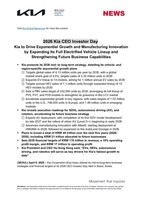
SEOUL, South Korea, April 9, 2026 /PRNewswire/ -- Kia Corporation (Kia) today shared its mid-to-long-term business strategies and financial targets at its 2026 CEO Investor Day held in Seoul, Korea.

This year's event focused on reviewing the five-year progress of Kia's 'Total Transformation' initiative, following the company's brand relaunch in 2021. Kia also outlined its mid- to long-term growth roadmap across all business sectors.
"Building on the achievements of innovation across all areas over the past five years —including brand, EVs, PBVs, and ESG — EVs, HEVs, autonomous driving, and robotics will serve as key drivers for Kia's fastest growth to date. Even amid the evolving global environment, Kia will proactively respond to changing market conditions through differentiated strategies." – Ho Sung Song, President and CEO of Kia Corporation.
2030 Mid- to Long-Term Business Strategy
Kia aims to pursue a strategy to accelerate exponential growth, targeting global sales of 4.13 million units by 2030 with a 4.5 percent market share. This compares with a sales goal of 3.35 million units with a 3.8 percent market share in 2026.
Kia places customers at the centre of its business strategy and, over the mid- to long-term, the company intends to expand its mobility ecosystem with a strategic focus on PBVs, autonomous driving, and robotics, connecting people and infrastructure to drive enhanced value creation for both customers and wider society.
Overview of Key Announcements at Kia 2026 CEO Investor Day
Category | Content | ||
2030 | Global Sales Targets |
| |
ICE & HEV |
| ||
EV | Sales Target |
| |
Enhancing EV Product |
| ||
Improving EV Accessibility |
| ||
Strengthening |
| ||
PBV |
| ||
Regional | U.S. |
| |
Europe |
| ||
Emerging |
| ||
Future | Autonomous Driving |
| |
Robotics |
| ||
2026 Business Plan & |
| ||
For more information, visit the Kia Global Newsroom.
Photo - https://mma.prnewswire.com/media/2953023/Image_1__2026_Kia_CEO_Investor_Day.jpg
PDF - https://mma.prnewswire.com/media/2953024/Press_release__2026_Kia_CEO_Investor_Day.pdf
 View original content to download multimedia:https://www.prnewswire.co.uk/news-releases/2026-kia-ceo-investor-day-kia-to-drive-exponential-growth-and-manufacturing-innovation-by-expanding-its-full-electrified-vehicle-lineup-and-strengthening-future-business-capabilities-302738080.html

Die gelbe Streudose mit roter Kappe ist längst mehr als ein Produkt aus dem Supermarktregal. Für viele Haushalte in der Schweiz gehört Aromat seit Generationen selbstverständlich auf den Tisch – als Geschmacksverstärker und als Teil einer alltäglichen Erinnerungskultur. Nun sorgt der geplante Zusammenschluss der Lebensmittelsparte von Unilever mit dem US-Unternehmen McCormick für Unruhe. Die Marke Knorr, unter der Aromat vertrieben wird, gehört zwar bereits heute dem britisch-niederländischen Konzern Unilever, doch die Produktion blieb bislang im Werk Thayngen im Kanton Schaffhausen verankert.
Genau diese Verankerung steht nun zur Disposition. Der Basler Jungunternehmer Michael Oehl hat unter dem Titel «Aromat ghört dr Schwiiz» eine Petition lanciert, die eine Produktionsgarantie für Thayngen sowie die Bewahrung des vertrauten Rezepts fordert. Für Oehl ist Aromat «kein gewöhnliches Produkt», sondern Teil der «Schweizer DNA» und eine Kindheitserinnerung. Innerhalb kurzer Zeit sammelte die Initiative nahezu 10'000 Unterschriften und stösst damit landesweit auf Resonanz – quer durch Sprach- und Gesellschaftsgrenzen. Medien in der Deutschschweiz und der Romandie greifen das Thema auf, Beobachter sprechen von einem neuen Symbolfall im Streit um den vermeintlichen Ausverkauf heimischer Traditionsmarken.
Im Zentrum der Debatte steht neben der emotionalen Aufladung ein handfestes industriepolitisches Risiko. Im Werk Thayngen sind rund 180 Arbeitsplätze an der Aromat-Produktion gekoppelt. Die von der Fusion erwarteten Synergien und Kosteneinsparungen nähren Befürchtungen, dass der Standort geschwächt oder verlagert werden könnte. Bisher liegt keine offizielle Entscheidung über die Zukunft der Fabrik vor, doch die Aussicht auf strukturelle Anpassungen reicht aus, um Belegschaft, Regionalpolitik und Konsumenten zu mobilisieren. Für die Petitionäre geht es dabei um mehr als Nostalgie: Sie verweisen auf das vorhandene Know-how, die lokale Wertschöpfung und die Rolle von Marken wie Aromat für das industrielle Rückgrat ländlicher Regionen.
Oehl will bei einer symbolischen Marke nicht stehen bleiben. Die Bewegung soll ausgebaut, das Unterschriftenziel auf 20'000 erhöht werden. Anfang April hat er den Verein «Aromat ghört dr Schwiiz» gegründet, der als organisatorische Plattform dienen soll. Perspektivisch skizziert er Modelle wie eine «Aromat Schweiz AG» oder eine Genossenschaft mit Volksaktien, an der sich Konsumentinnen und Konsumenten direkt beteiligen könnten. Ob sich solche Vorstellungen mit den strategischen Plänen eines globalen Lebensmittelkonzerns vereinbaren lassen, ist offen. Klar ist jedoch: Die Auseinandersetzung um Aromat hat eine breitere Diskussion darüber entfacht, wie viel Kontrolle die Schweiz über ihre Konsumikonen behalten will – und welchen Preis sie bereit ist, dafür zu zahlen.