TAIPEI, June 3, 2026 /PRNewswire/ -- From June 2 to 5, COMPUTEX 2026 in Taipei runs under the theme "AI Together." Longsys (301308.SZ) showcases its full-stack edge AI storage portfolio under "Edge AI Storage • Integrated Implementation," together with its high-end consumer storage brand Lexar, to optimize local LLM performance and accelerate AI ecosystem collaboration.
Global Launch: AIDIMM™ & AILPBGA™ for Edge AI Inference
AIDIMM™ delivers up to 128GB capacity, 256-bit bus, and 307.2GB/s bandwidth in a compact form factor. It resolves memory, thermal, and upgrade pain points of AI agent hosts—a single module reliably and stably runs edge LLMs with over 70 billion parameters. Dynamic voltage scaling (0.9V–1.05V) and FDVFS power tuning enable high-performance, low-power mass deployment.
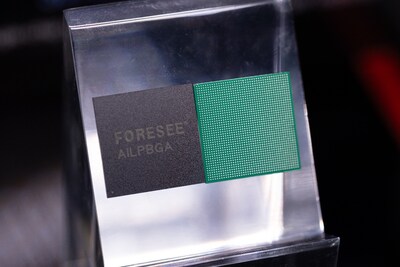
AILPBGA™ is a high-bandwidth chip for compact embedded AI inference. It offers 24–64GB capacity, 307GB/s bandwidth, native LPDDR compatibility, and a 22×22mm package. Compared to cloud AI high-bandwidth memory, it balances cost and power; versus LPDDR5x, it delivers multiple times the performance without SoC redesign, shortening development cycles and reducing costs.
Hardware-Software Storage Integration for Edge AI Compute-Storage Applications
SPU™ (Storage Processing Unit) + iSA™ (Intelligence Storage Agent) integrates HLCache™ to cut DRAM usage and hardware costs. The iSA™ scheduling engine uses expert offloading, intelligent cache management, and predictive prefetch to tackle MoE LLM challenges—improving local AI inference smoothness. Live demo on AMD Ryzen AI Max+ 395: 128GB DRAM runs a 397B LLM; 64GB runs 80B/122B LLMs smoothly.
HLCache™-enabled UFS boosts DRAM scheduling efficiency, allowing mobile terminals with lower-spec memory to run 13B/20B AI models. Live comparative demos confirm a smooth experience comparable to devices with much larger DRAM—optimizing BOM costs and extending device lifespan.
High-Speed mSSD Storage Media with Integrated Thermal Management for Storage Applications
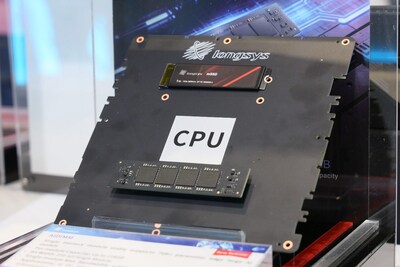
Longsys displays Gen4/Gen5 mSSD using wafer‑level SiP. Gen5 mSSD delivers 11/10 GB/s sequential, 2.2M/1.8M IOPS, up to 8TB, with VC liquid cooling for sustained peak performance. Gen4 mSSD has achieved commercial deployment with major PC OEMs.
Global Expansion and Brand Power Drive Edge AI Adoption
Lexar debuts AI‑Grade Gen5 storage based on AI Storage Core, improving edge AI efficiency while reducing DRAM needs for AI PCs, smart imaging, and robotics. Celebrating its 30th anniversary and the upcoming FIFA World Cup, Lexar launches Argentina National Football Team co‑branded PSSD/USB drives. Founded in 1996, Lexar has global reach via Costco, Best Buy, and e‑commerce platforms, bringing edge AI storage solutions to worldwide creators and edge computing.
Looking ahead, Longsys will continue leveraging its full‑stack storage foundry capabilities to deliver practical, industry‑benchmarking edge AI storage solutions.
About Longsys
Founded in 1999, Longsys (301308.SZ) is a globally leading branded semiconductor memory enterprise, integrating R&D, design, packaging and testing, manufacturing, and sales services. For more information please visit https://www.longsys.com/, and follow Longsys on LinkedIn and Facebook.
Photo - https://mma.prnewswire.com/media/2994151/image1.jpg
Photo - https://mma.prnewswire.com/media/2994150/image2.jpg
 View original content:https://www.prnewswire.co.uk/news-releases/aidimm--ailpbga-make-global-debut--longsys-spotlights-full-stack-edge-ai-storage-at-computex-2026-302790059.html

Sandoz hat im ersten Quartal 2026 trotz erheblicher Verwerfungen im Penicillin-Geschäft weiteres Wachstum erzielt. Der Umsatz des Schweizer Generika- und Biosimilar-Spezialisten belief sich zwischen Januar und März auf 2,76 Milliarden US-Dollar, ein Plus von 11 Prozent gegenüber dem Vorjahreszeitraum. Zu konstanten Wechselkursen legten die Erlöse um 3 Prozent zu. Der Konzern bestätigt nach eigenen Angaben seinen Ausblick für das Gesamtjahr.
Treiber der Entwicklung war vor allem das höhermargige Biosimilar-Geschäft, das die frühere Novartis-Tochter weiter ausgebaut hat. Dagegen stand die grössere Generika-Sparte erneut unter Druck, weil sich die Marktverwerfungen im Penicillin-Segment fortsetzten. Klammerte man die negativen Auswirkungen aus dem Antibiotika-Geschäft aus, hätte das Umsatzplus zu konstanten Wechselkursen bei rund 5 Prozent gelegen und damit im Rahmen der Unternehmensprognose.
Die Belastungen resultieren aus einem anhaltenden Preisverfall bei wichtigen Penicillin-Wirkstoffen (Active Pharmaceutical Ingredients), der bereits im Vorjahr eingesetzt hatte. Hintergrund sind US-Zölle, die chinesische Anbieter dazu veranlasst haben, ihre Penicillin-Mengen verstärkt nach Europa umzuleiten. Das zusätzliche Angebot hat dort die Preise deutlich gedrückt. Parallel dazu führten in Indien eingeführte Mindestpreisvorschriften dazu, dass weniger chinesische Ware in diesen Markt floss, was den Wettbewerbsdruck in Europa zusätzlich verschärfte und den Preisdruck weiter verstärkte.
Laut Sandoz konzentrieren sich die heftigsten Auswirkungen dieser Entwicklung auf das erste Quartal, die verbleibenden Effekte sollen sich nun schrittweise abschwächen. Analysten verweisen darauf, dass das Unternehmen ohne den Antibiotika-Gegenwind im Rahmen seiner Guidance gewachsen wäre. Der Konzern bleibt damit auf Wachstumskurs, muss sich im Generika-Kerngeschäft jedoch weiterhin in einem von handelspolitischen Eingriffen und regulatorischen Änderungen verzerrten Marktumfeld behaupten.